Innovation in robotic surgery: touchless 3D navigation
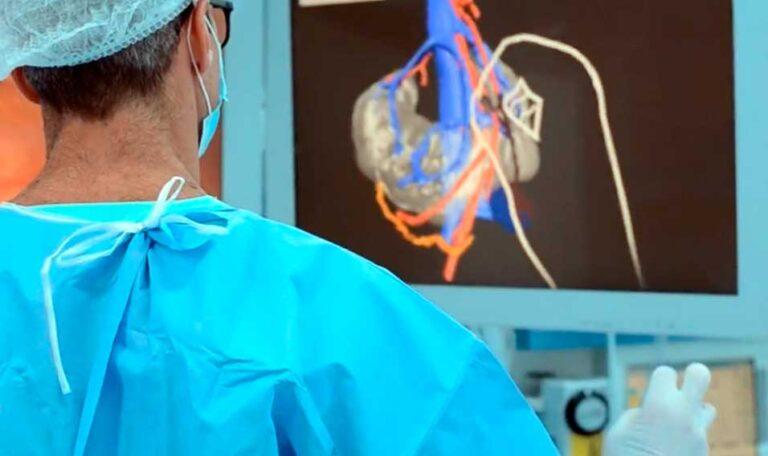
Dr. Gonzalo Vitagliano, UMIBA & Hospital Alemán de Buenos Aires. Ing. Lucas Mey, MIRAI 3D Technology Team.
A surgical robot is an automated medical system designed to enhance surgeons' performance in minimally invasive procedures. These systems improve the efficiency and precision of surgery while, as a rule, shortening the patient's recovery time.
Robotic partial nephrectomy with 3D reconstruction.
Its applications span many areas: general surgery, gynecologic surgery, urologic surgery, cardiac surgery, and thoracic surgery, among others.
In recent years, the rollout of new robots in medical centers worldwide has grown exponentially, driven by the launch of new and innovative surgical platforms.
A race to stand out and innovate
The competition to lead the technology of surgery is at its peak, and several proposals stand out within it: the da Vinci by Intuitive Surgical, the first robot on the market and the only one for almost two decades; the Hugo RAS by Medtronic; the Versius by CMR Surgical (Cambridge Medical Robotics); and Hinotori, by the Japanese company Medicaroid (a division of industrial-robotics leader Kawasaki).
Versatility
The Hugo RAS and Versius designs aim to offer greater flexibility by splitting the traditional central tower into separate modular robotic arms. Versius, in particular, stands out for its lightweight arms, easy to combine and considerably lighter than the market average.
Operability
With these new models, the user experience begins to see a significant evolution. Companies such as Medtronic and CMR Surgical are betting on flat-screen systems with 3D visualization, and in the case of Versius, on replicating laparoscopic surgery as closely as possible by replacing foot pedals with clutches in the hand controls. Hinotori also stands out here, with a smart, ergonomic console that adapts to the surgeon's preferences for greater comfort.
Single-port
Intuitive could not fall behind with so many competitors emerging, and doubled down on minimal invasiveness by introducing its da Vinci SP model. This single-port design promises to simplify approaches that have been very challenging until now, such as retroperitoneal partial nephrectomy.
Accredited training with simulation: the key to success?
Knowing how to use a tool correctly is as important as, or more important than, the tool itself. The same is true of the new robotic platforms.
To bring a surgical robot on board, the surgeon must complete an accreditation process: a multi-stage training program to become familiar with the system's movements and features and to validate their skills, so patient safety is guaranteed.
Slowly, companies are realizing that to win markets and bring their technology into new institutions, they must invest in education and training rather than in marketing or events.
The trend leans heavily toward simulation, whether through high-fidelity hands-on models (Urotrainer, for example) or virtual training programs (especially for building basic skills: movements, knots, sutures, and so on).
At the same time, data systems that track a surgeon's skill progress, analyze the performance of a surgical history, and pinpoint areas to improve in technique are taking hold as a new standard.
New 3D navigation technology
Handling the patient's specific anatomy in real time
Simulation and training advance hand in hand with technologies that assist the surgeon inside the operating room, as is the case with 3D planning.
The MIRAI 3D engineering team developed a new interface that lets surgeons view and navigate the virtual biomodels directly on the robotic console.
What is new about this system is being able to handle the patient's anatomical model with your hand, without any contact at all.
For this, a small device is added; together with an infrared camera and hand-detection algorithms, it lets the surgeon rotate or zoom in mid-air, have those movements picked up by the camera, and see them translated onto the model the surgeon is viewing on the robot's console.
The new technology lets the surgeon move and position the model to get the optimal view at every moment of the surgery. Simply by moving a hand, without ever looking away from the viewer, the surgeon can study the biomodel while keeping full attention on the operation.
In conclusion…
Robotic surgery systems can offer several advantages over laparoscopic or open surgery: