Touchless 3D navigation for complex kidney tumors
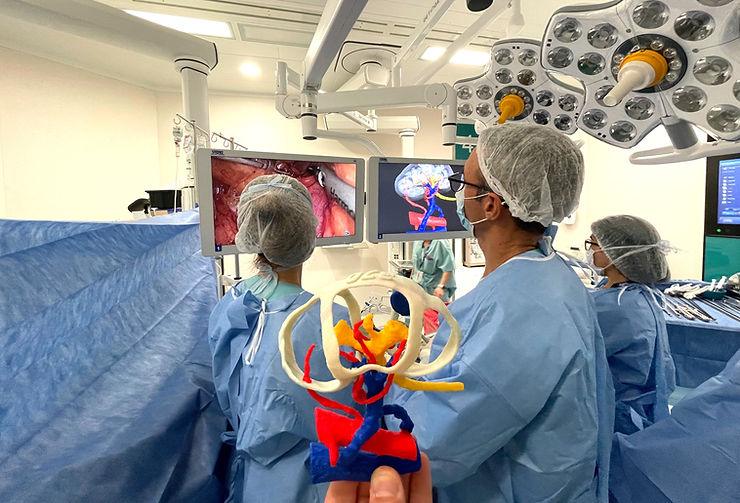
Dr. Gonzalo Vitagliano performed a laparoscopic partial nephrectomy without intraoperative ultrasound, thanks to 3D surgical planning. He also implemented the new touchless navigation technology during the surgery, to manipulate the 360º 3D reconstruction and locate the tumor with greater precision.
The 42-year-old patient came in with renal colic caused by a kidney stone on the left side. The specialist decided to perform a ureteroscopy, removing the stone and placing a double-J stent.
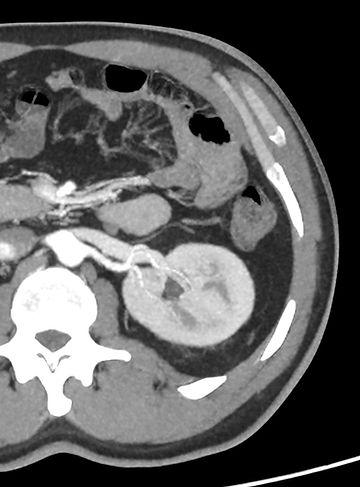
During the diagnosis of the stone (in the left ureter), an incidentaloma was found, that is, a completely endophytic kidney tumor. The tumor was 18 mm in diameter, with a RENAL score of 8p, as can be seen in the CT images.
Given the patient's condition, it was decided to leave the stent in place and schedule a laparoscopic partial nephrectomy.
How was the surgical approach with the biomodel?
No intraoperative ultrasound was used; instead, the 3D biomodel was used to locate the lesion precisely. To do this, a measurement was taken on the physical 3D model before surgery, so the tumor could then be found in the operating room without complications.
The new touchless 3D navigation technology was used: RESULTS AND BENEFITS
For this surgery, the new touchless 3D navigation technology was implemented, which allows the surgeon to manipulate the virtual biomodel without contact and explore every detail of the patient's anatomy in real time. As a result:
The patient recovered perfectly.
The ischemia time was 20 minutes.
Given the good recovery, the patient was discharged after 48 hours.
This technology allows the surgeon to fully control the patient's anatomical information and the 3D reconstruction without needing another professional's help. The surgeon has complete control of the surgical navigation in real time and first person.
“The surgeon has full control of the navigation and of the image to assist in the surgery without external help. He can manipulate the digital 3D model without contaminating himself. The risk of contamination involved in relying on an external element disappears,” Dr. Vitagliano concluded about his experience with this new technology.